

Arriving at Auckland Airport with four, six, eight or more passengers can turn a simple airport transfer into a logistical headache. A regular taxi may be perfectly comfortable for one or two people, but once you add several passengers, suitcases, carry-on bags and possibly a child seat or mobility equipment, space becomes the real issue.
This is where choosing between a standard taxi and an Auckland taxi van and maxi taxi booking service becomes important.
For small groups, a regular taxi can still make sense. For families, sports teams, wedding parties, corporate groups or travellers carrying substantial luggage, a maxi taxi or passenger van often offers a more practical solution.
The cheapest-looking option is not always the most economical once you consider how many vehicles you need, how luggage is distributed and whether everyone can travel together.
This guide explains the differences between the two options, when each works best, what to check before booking, and how to assess an affordable maxi taxi Auckland option without sacrificing comfort or reliability.
Maxi Taxi vs Regular Taxi: Understanding the Difference
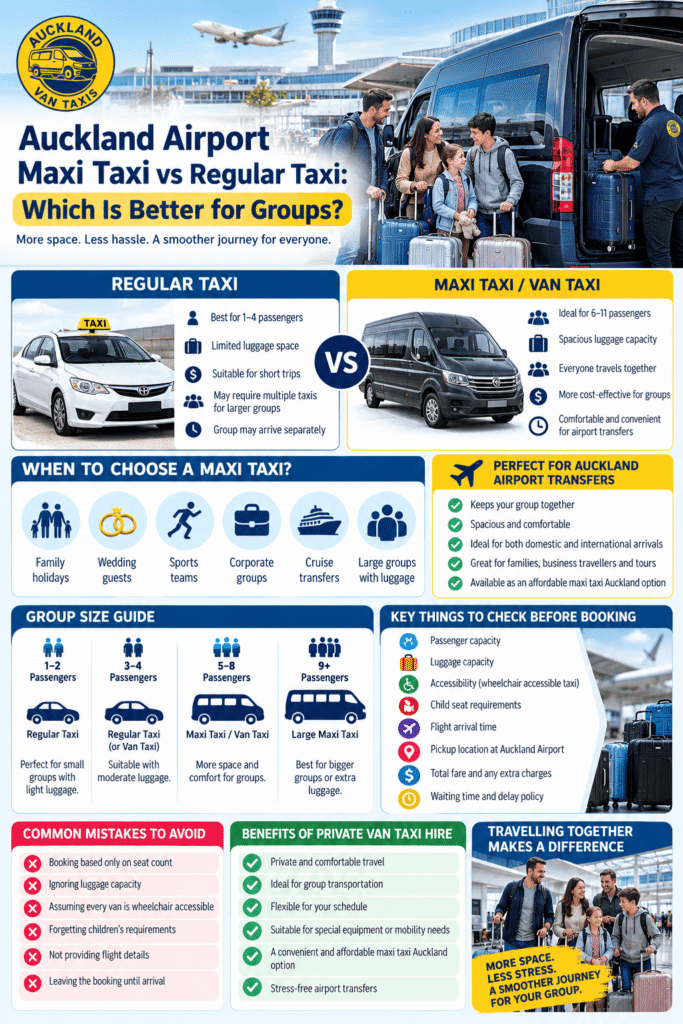
The basic distinction is simple: a regular taxi is designed primarily for smaller passenger groups, while a maxi taxi is intended to carry more people in one vehicle.
However, the practical difference goes beyond the number of seats.
A group airport transfer involves three things that individual travellers often overlook:
- Passenger capacity
- Luggage capacity
- Coordination
Imagine a family of seven arriving at Auckland Airport with six large suitcases, several backpacks and a stroller. Technically, arranging multiple regular taxis may get everyone to the destination. But the group becomes divided, luggage has to be allocated between vehicles and everyone needs to arrive at roughly the same time.
A suitable maxi taxi can potentially keep the group together.
That matters particularly when the destination is a hotel, holiday accommodation, cruise terminal, wedding venue, conference centre or another location where the entire group needs to arrive together.
When a Regular Taxi Makes More Sense
A regular taxi can be a sensible choice when:
- There are only one or two passengers.
- The group has very little luggage.
- Passengers are travelling separately.
- The journey is short.
- Everyone does not need to arrive together.
- A larger vehicle would provide unnecessary capacity.
For three or four passengers with modest luggage, the decision may depend on the vehicle’s actual luggage space rather than passenger capacity alone.
When a Maxi Taxi Becomes More Practical
A maxi taxi becomes more attractive when:
- You have a larger family or group.
- Several passengers are travelling from the airport together.
- There are multiple suitcases.
- Travellers want to remain together.
- The group has elderly passengers or mobility requirements.
- There is a tight schedule.
- Coordinating several taxis would be inconvenient.
The key question should therefore be: What is the most practical vehicle for the whole journey, rather than simply the lowest advertised fare for one vehicle?
Auckland Taxi Airport Transfers: What Changes When You Travel as a Group?
Airport travel has different requirements from an ordinary city taxi trip.
People leaving Auckland Airport often have more luggage, unfamiliar surroundings and a fixed destination. They may also have connecting travel plans, hotel check-in times or family members waiting at the destination.
For larger groups, these factors make vehicle selection more important.
Consider a group of six passengers.
With a regular taxi arrangement, you might need two vehicles. That means:
- The group has to split.
- Luggage needs to be divided.
- Both vehicles need to find the destination.
- Passengers may arrive at different times.
- Communication becomes more complicated.
With an appropriate maxi taxi, the entire group may be able to travel together.
This is one reason private group transportation is useful for airport journeys. The benefit is not necessarily luxury; it is coordination.
Group Transfer: Why Vehicle Capacity Matters More Than You Think
When people compare airport transport prices, they often look only at passenger numbers.
Experienced travellers also consider usable luggage capacity.
A vehicle may have enough seats for eight people but still be unsuitable if eight passengers arrive with large suitcases.
Passenger Capacity Isn’t the Same as Practical Capacity
Suppose a group includes:
- 7 adults
- 7 large suitcases
- 7 carry-on bags
A vehicle with seven or eight seats might technically accommodate the passengers, but that does not automatically mean it can accommodate their belongings comfortably.
Before booking, ask about both:
Passenger capacity + luggage capacity
This is particularly important for international arrivals.
Airport Transfers Need a Little More Planning
A good group transfer booking should account for:
- Number of passengers
- Number and type of bags
- Flight arrival time
- Destination
- Special mobility requirements
- Child passengers
- Desired pickup arrangement
If someone in the group uses a wheelchair, for example, the appropriate vehicle may be very different from an ordinary passenger van.
Auckland Maxi Taxi for Group Travel: When Is It the Better Choice?
An Auckland maxi taxi for group travel can be particularly useful when everyone has the same origin and destination.
Think about these real-world situations.
Family Arriving for a Holiday
A family of eight arrives from overseas for a two-week holiday. They have multiple suitcases and a stroller.
Splitting the family across taxis can make the first part of the holiday unnecessarily complicated.
A larger vehicle allows everyone to leave the airport together and reduces the need to coordinate separate drivers.
Wedding Guests
A group travelling from Auckland Airport to a wedding venue may need to arrive within a particular time window.
A group vehicle can simplify the journey, particularly if passengers are staying at the same accommodation.
Sports Teams
Sports teams frequently travel with equipment that takes up more room than ordinary luggage.
A booking should therefore account for both passenger numbers and equipment.
Corporate Groups
A business group attending a conference may prefer travelling together rather than arranging individual airport taxis.
The journey can also become a useful transition period between the airport and the meeting venue.
Van Taxi: When a Passenger Van Is the Practical Middle Ground
A Van Taxi can provide a useful middle ground between a conventional taxi and a larger group vehicle.
Passenger vans are particularly suitable for groups that need additional seating and luggage room without necessarily requiring a very large vehicle.
The important point is that “van” does not automatically mean “suitable for every group.”
Vehicle configurations differ.
Before confirming an Auckland taxi van and maxi taxi booking service, check:
- Maximum passenger capacity
- Available luggage space
- Whether luggage affects seating
- Door configuration
- Accessibility features
- Child-seat requirements
- Pickup arrangements
A quick conversation before booking can prevent a surprisingly common airport problem: discovering that the vehicle has enough seats but not enough usable space.
Passenger Van Transportation for Different Group Sizes
There is no single ideal vehicle for every group.
2–3 Passengers
A regular taxi will usually be the straightforward option, particularly with normal luggage.
4–5 Passengers
The decision depends heavily on luggage.
A regular taxi may work for a light load, while a larger vehicle can be more comfortable for several large bags.
6–8 Passengers
A maxi taxi or suitable passenger van often becomes more practical because keeping everyone together can simplify the transfer.
Larger Groups
For larger parties, one vehicle may not always be appropriate. Multiple coordinated vehicles may provide a better balance between capacity, comfort and travel time.
The important thing is to plan according to the actual group, not simply the number printed on a vehicle description.
Wheelchair Accessible Taxi: Accessibility Should Be Discussed Before Booking
Passengers who use wheelchairs or have significant mobility requirements need more than a vehicle with extra seats.
A wheelchair accessible taxi may require features such as:
- Appropriate wheelchair entry
- Adequate internal clearance
- Securement arrangements
- Suitable ramp or lift access
- Enough room for the passenger and mobility equipment
Accessibility requirements can vary considerably between passengers.
For example, someone who can transfer from a wheelchair into a vehicle has different requirements from someone who needs to remain seated in their wheelchair during transportation.
This should be discussed at the booking stage.
Don’t simply state that a passenger “needs accessibility.” Explain the actual requirement so the operator can determine whether the available vehicle is suitable.
Private Van Taxi Hire Auckland: When Privacy and Flexibility Matter
For families, business travellers and private groups, private van taxi hire Auckland can offer an advantage beyond passenger capacity.
The group travels together without having to coordinate with unrelated passengers.
This can be particularly useful for:
- Airport-to-hotel transfers
- Family holidays
- Corporate travel
- Wedding transportation
- School or community groups
- Sporting events
- Day trips
- Cruise transfers
Private transportation can also make the journey easier for groups carrying specialist equipment or travelling with young children.
However, “private” should not be interpreted as automatically meaning premium or luxury. Ask what is actually included in the booking.
Affordable Maxi Taxi Auckland: How to Judge the Real Cost
Searching for an affordable maxi taxi Auckland option is sensible, but comparing prices requires a little care.
The lowest quoted price is not necessarily the lowest overall cost.
Suppose six passengers need airport transportation.
Option A involves two regular taxis.
Option B involves one appropriately sized maxi taxi.
Even if the maxi taxi has a higher individual fare, the total group cost may be competitive once both regular taxi fares are considered.
There are also non-financial costs:
- Splitting the group
- Waiting for another vehicle
- Dividing luggage
- Coordinating drivers
- Arriving separately
- Managing children across vehicles
Questions Worth Asking Before Booking
Instead of asking only “How much?”, ask:
- How many passengers can the vehicle comfortably carry?
- How much luggage can it accommodate?
- Is the quoted price for the whole vehicle or per passenger?
- Are airport-related charges included?
- Is there an additional waiting charge?
- How is flight-delay pickup handled?
- Can special luggage be accommodated?
- Is accessibility available if required?
Transparent pricing is much easier to compare than a headline figure without context.
Common Mistakes When Booking Airport Group Transport
Even experienced travellers make avoidable mistakes when organising transportation for several people.
Mistake 1: Booking Based Only on Seat Count
Eight seats does not necessarily mean eight passengers plus eight large suitcases.
Always discuss luggage.
Mistake 2: Assuming Every Van Is Accessible
A passenger van may have plenty of seats but no appropriate wheelchair access.
Confirm the exact accessibility requirements.
Mistake 3: Forgetting Children’s Requirements
Families should mention children’s ages and any required child restraints when making the booking.
Do not assume the operator will know this automatically.
Mistake 4: Ignoring Flight Delays
Airport pickups are different from ordinary point-to-point journeys.
Give the operator accurate flight information when requested and clarify how delayed arrivals are handled.
Mistake 5: Comparing Only the Cheapest Quote
A very low quote may not tell you the complete story.
Compare the vehicle, capacity, luggage allowance, pickup arrangements and total journey cost.
Mistake 6: Leaving the Booking Until Arrival
Large vehicles are not always as readily available as standard taxis.
For a larger group, advance planning is generally the safer approach.
Expert Tips for a Smoother Auckland Airport Group Transfer
1. Count Bags, Not Just People
Write down the approximate luggage requirement before booking.
For example:
7 passengers + 6 large suitcases + 5 carry-ons + 1 stroller
This is much more useful than simply saying “seven people.”
2. Give Accurate Arrival Information
If the transfer is connected to an arriving flight, provide the correct flight details where requested.
This helps establish the expected arrival window.
3. Ask Where the Driver Will Meet You
Airport pickup arrangements can vary.
Confirm whether the driver will meet the group at a designated pickup point, whether passengers should call after collecting luggage, or whether another process applies.
4. Plan for the Slowest Traveller
If one passenger is elderly, travelling with young children or requires mobility assistance, allow additional time.
A group transfer should work for everyone, not just the fastest passenger.
5. Keep the Booking Details Accessible
The group organiser should have:
- Booking confirmation
- Pickup instructions
- Destination address
- Passenger count
- Operator contact information
- Special requirements
This prevents confusion when everyone has just arrived at the airport.
A Simple Decision Guide: Maxi Taxi or Regular Taxi?
Use this quick comparison when deciding.
| Situation | Regular Taxi | Maxi Taxi / Van |
| 1–2 passengers | Excellent choice | Usually unnecessary |
| 3 passengers with light luggage | Often suitable | Optional |
| 4 passengers with several large bags | May be tight | Often preferable |
| 6–8 passengers | May require multiple vehicles | Usually more practical |
| Large family | Less convenient | More convenient |
| Sports equipment | Potentially difficult | Better suited |
| Wheelchair user | Depends on vehicle | Confirm accessibility |
| Group needs to stay together | Not ideal with multiple cars | Strong advantage |
| Corporate group | Possible | Often more coordinated |
| Large amount of luggage | Limited by vehicle | Generally more flexible |
The table is a starting point rather than a substitute for confirming the actual vehicle.
When a Regular Taxi Is Still the Better Option
It would be misleading to suggest that a maxi taxi is always superior.
A regular taxi can be the better choice when the group is small and luggage is limited.
For example, two travellers arriving with two suitcases may gain nothing from booking a much larger vehicle.
Likewise, if four passengers are travelling to different destinations, putting everyone into one vehicle may not be practical.
The best transport decision depends on the complete journey.
The goal is not to choose the biggest vehicle available. It is to choose the right-sized vehicle for the people, luggage, route and circumstances.
Practical Booking Checklist
Before finalising an Auckland taxi van and maxi taxi booking service, run through this checklist:
Passengers
- Exact number of travellers confirmed
- Children identified
- Mobility requirements identified
Luggage
- Large suitcases counted
- Carry-on bags considered
- Strollers or sports equipment mentioned
Journey
- Auckland Airport pickup confirmed
- Destination address provided
- Flight details provided where applicable
- Preferred pickup instructions understood
Vehicle
- Passenger capacity confirmed
- Luggage capacity confirmed
- Accessibility confirmed if required
Price
- Total fare understood
- Extra charges clarified
- Waiting or delay policy understood
This takes only a few minutes and can prevent much bigger problems later.
Final Takeaway
Choosing between a regular taxi and a maxi taxi for Auckland Airport is really a question of capacity, coordination and convenience.
A regular taxi remains a sensible choice for smaller groups with limited luggage. But once you are travelling with several passengers, multiple suitcases, children, mobility equipment or a fixed group schedule, a suitable maxi taxi or passenger van can make the entire journey easier.
The most reliable approach is to look beyond the advertised fare. Tell the operator exactly how many people are travelling, how much luggage you have and whether anyone has special requirements.
For travellers comparing an affordable maxi taxi Auckland option, the best value is not necessarily the lowest number on a quote. It is the option that provides the right vehicle, sufficient space and a straightforward airport transfer without unnecessary complications.
When those details are handled before the booking, airport transportation becomes much less stressful—and the whole group can start the Auckland journey together.
FAQ: Auckland Airport Maxi Taxi vs Regular Taxi
1. Is a maxi taxi better than a regular taxi for airport groups?
Not automatically. A regular taxi can be perfectly suitable for one or two passengers, while a maxi taxi becomes more practical as passenger and luggage numbers increase. For a group of six or more travelling to the same destination, keeping everyone together can make the larger vehicle considerably easier to manage.
2. How many people should consider booking a maxi taxi?
There is no universal passenger number because luggage matters just as much as seating. A group of four with substantial luggage may need a larger vehicle, while three passengers with small bags may comfortably use a regular taxi. The best approach is to provide the operator with both passenger and luggage numbers before booking.
3. Is an affordable maxi taxi Auckland option always cheaper than taking several taxis?
Not necessarily, but it can be more economical for larger groups when the total cost of multiple taxis is considered. You should compare the complete group fare rather than comparing the price of one regular taxi with one maxi taxi. Convenience, luggage capacity and keeping the group together should also be included in the decision.
4. Can a maxi taxi accommodate wheelchair users?
Some vehicles are specifically configured for wheelchair accessibility, but a standard maxi taxi should not automatically be assumed to be accessible. Explain whether the passenger can transfer from their wheelchair or needs to remain seated in it during the journey. The operator can then identify the appropriate vehicle configuration.
5. How early should I arrange an Auckland Airport group transfer?
For a larger group, booking in advance is generally sensible, particularly when the transfer involves substantial luggage, accessibility requirements, children’s equipment or a specific arrival time. Advance booking gives the operator a better opportunity to allocate a suitable vehicle instead of relying on whatever happens to be available at the airport.
